WANT TO LEARN MORE? GOOGLE IT. :)

Showing posts with label PH stocks. Show all posts

Saturday, September 26, 2015

STOCKS 101 | P/E Ratios by Industry (from PSE Data) - End of September 2015

Last August 2015, I released a mid-August Investment Guide tabulating the price-to-earnings (P/E) ratios of some public Philippine companies. It was also on that post linked above where I (somewhat po hehe) thoroughly explained what a P/E ratio is and does.

(I'm making this post extremely short para 'di na po kayo ma-bore hehe. Enjoy and have a good one!)

Today, I am posting an updated list of P/E ratios for several PH companies that are being traded in the market. It can be noted that since the one-day 7.20% loss in August 24, some stocks have managed to recover, while others continued their downward trend.

What I discovered is that almost all companies had their P/E ratios lowered which means, from a value investor and share price-point perspective, some stocks are less expensive (or in another sense, cheaper) than they were in August. So, how do these stocks' P/E ratios fare relative to its competitors in the same sector/category?

1. BANKS AND FINANCIALS


It must be noted, however, here that price-to-book (P/B) ratios are better indicators for banks because they have a lot of assets and liabilities that are constantly valued at market prices.

P/E Relatives
Cheapest: UBP, RCB


2. COMMERCIAL AND INDUSTRIAL


P/E Relatives
Cheapest: EEI, IMI, MWC

Some companies are a bit highly priced like media companies ABS and GMA7 because they know election is just several months ahead. And election means big bucks! ICT, if I remember, had a P/E of 30+. Now, it's nearing the 20-level, which means it has gotten a lot less expensive. PCOR, on the other hand, still possibly suffering from losses has a negative P/E. This may mean that investor currently value the stock at or pay 46 pesos for every 1 peso loss made.


3. CONGLOMERATES


P/E Relatives
Cheapest: FPH

FPH which holds shares in EDC and FGEN, if I am not mistaken, has the lowest P/E ratio in this list. Some PSEi listed companies like GTCAP, A, JGS, LTG, and SM all are priced higher.


4. CONSUMER


P/E Relatives
Cheapest:  DNL

It's a shocker that DNL is currently having a relatively low P/E (and is the cheapest) considering the fact that it was performing well (skyrocketing extraordinarily) in the past several months. It goes to show that the PH market's overall sentiment could not be estimated. Well, JFC and URC are again two of the most priced (or prized haha) jewels in the stock market. They're some of the investors' darlings; I can say; however, do notice their trends (via Wall Street Journal, PSE Edge, Bloomberg, or your online stock brokers' platform), 

Kids (and investors) just love Jollibee and junkfood, I guess hehe.


5. GAMING


P/E Relatives
Cheapest: RWM

The reduced confidence and potential in gaming firms (70% down, yep you're reading that right) in Macau may have had an indirect impact on investor appetite here in the Philippines. To where is the PH gaming industry headed?


6. MINING, POWER, AND TELECOM


P/E Relatives
Cheapest: NIKL (Mining), TEL (Telecom), EDC and FGEN (Power)

We got some extremes in the mining, telecom and power category. On one hand, NIKL is definitely the second cheapest stock in this guide. What has possibly lowered its P/E? Is it China's (a major nickel importer) slowdown? Meanwhile, EDC and FGEN, two power generating firms, are exposing their affordable value as they have the lowest P/E ratios in this power list. TEL, or PLDT, has just gotten a lot more cheap when it neared a 52-week low of 2,240 PHP last September 23.


6. PROPERTY

P/E Relatives
Cheapest: CPG, MEG, VLL

The property category boasts of the widest spectrum with CPG being the cheapest (on a P/E ratio) and real estate giants ALI and SMPH with extremely high P/E ratios. Again, it should be noted that P/E is not the only indicator out there. CPG has a low P/E ratio, but there must be something going on (or probably wala din) which is preventing investors from paying a higher price for that stock. Due diligence should be practiced at all times. Research, research, research. Hehe.

NOTE: 
This guide only shows the strength of P/E ratios relative to one another. (I only mentioned what  are obvious, P/E wise.) 

A low P/E ratio may suggest that at it's current value, it's priced as cheap. But it may also mean that investors aren't just upbeat on it and aren't willing to pay a premium (extra) to own part of the company. On an earnings perspective, a low P/E ratio may indicate that the company has had higher earnings to date which may mean it's a valuable stock for the future, fundamentally, although usually a higher earnings report leads to an increase in the stock price. 

However, earnings aren't just the only representation of a company's financial progress. Is a company piling huge debts? Was it involved in any tragedy? Is it hindered by certain legal processes (judicial proceedings, TROs)? Caveat!

Monday, August 24, 2015

BREAKING NEWS | PH stock market crashes

Just in.

The Philippine stock market, represented by the Philippine Stock Exchange Composite Index (PSEi) among other indices, has shed 6.40% to 6812.13 in its morning day trade. The most active stocks during the morning trade are ALI (-8.09%), GTCAP (-9.18%), BDO (-7.53%), AC (-5.96%), and SM (-8.47%). 68,402 trades took place on the first three hours of the trading day.

Philippine Stock Market - Top Losers (Morning Trade) - August 24

 Philippine Stock Market - Top Gainers (Morning Trade) - August 24

Philippine Stock Market - Most Active (Morning Trade) - August 24

What happens next? We'll we see a panic selling which could turn into a full-blown stock market crash? Or is this just a big market correction?

Let's see this afternoon and in the coming days.

In its afternoon trade, the PSEi lost more points now ending at  a loss of 7.20% to 6,754.74 before trading was halted (around 2:07 PM) due to technical issues - market data delay in PSETRADEX.

The trading floor once again opened around 2:50 PM. It ended -6.70% to 6,791.01. The most active stocks for the day are ALI (-9.03%), GTCAP (-10.13%), URC (-6.49%), AC (-6.69%), and TEL (-7.78%).

What happens tomorrow? We'll see.

Sunday, August 23, 2015

STOCKS 101 | 5 Free Online Stock Trading Simulation Games

If you're a newbie in stock investing and wouldn't want to shell out money first because you think you lack the knowledge, then you can try simulators of stocks trading or simulation games which can serve beneficial and pose no risk when it comes to money (since virtual money is only involved) but there's a risk of information sharing (because most of these can be accessed using Facebook) though so be warned hehe.

Here is a list of stock trading games which you may find helpful in have a good hold of the trading experience. Maybe you're still a bit scared of venturing into equities, which is really risky 'cause you can lose money in just a few weeks. But hey, these guys are here to at least let us realize what we still don't know about the world of stocks.

Hope you love this list I compiled (these are not ranked po hehe)!

1. Investopedia


Just visit this link. The good thing with this stock trading simulation game is that you can easily access it through Facebook. There's no need to sign up as long as your logged in Facebook.

As soon as you have access to the Investopedia Simulator, you are free to choose from a variety of games made both by the public and by Investopedia itself. When you begin the Beginners game (as seen in the image above), you'll have a starting value of $10,000. Try playing this game if you like. :)

2. Smart Stocks


Access to the Smart Stocks trading simulator is easy because you can log in through your Facebook account. Its setup is also manageable and convenient for anyone's understanding. 


Upon logging in, you'd be given the chance to create your own Fund Portfolio with an available cash of a whooping $1,000,000.00. One more thing one can do here is  to create as many portfolio as he/she wants. What I don't like about Smart Stocks though is the presence of ads hehe.

3. MarketWatch


MarketWatch's stock trading game is actually the first stock trading simulation platform I really used three to four years ago. It reflects live price fluctuations and real-time trading, plus it ranks the players based on net worth where you start first with $100,000.

There are a lot of trading games in this site, an example of which is shown above; note however that the game Philippine stocks exchange is already expired. 


Here's what to expect from MarketWatch's Game Board. Play the simulator here.

4. Wall Street Survivor


Wall Street Survivor has come up with a more creative, fun way to learn investing. Try it out through its website.


When you landed right on its page, you'll have to register through Facebook or email address. It would only take a few seconds to register.


I would have to believe that Wall Street Investor has one of the best interface I've seen when it comes to trading. Plus, there are a lot of cool stuff to check out like videos and some stock tips.

5. TradeHero

Actually an app rated 4/5 in Google Playstore, TradeHero is "mobile stock market simulation app that lets you learn about trading without any risk." One can also play this game just by logging in Facebook or Twitter,  aside from the traditional email address registration. The initial investment is $100,000. More than just learning how to trade, you actually get to earn money if people follow your trades.


Once registered, you'll be asked which exchange you'd like to trade in - in our case, the ticker is PSE.
You will then be requested to choose only one sector. It will then lead you to your profile page where your stock portfolio is featured. 

P.S. Note that these stock trading simulation games provide almost real-time info about the stocks you hold, so it's far from possible that you'll get to play the games on a weekend. Also, please take note that there are a lot of other trading simulators and apps out there. All you need to do is just search. :)

P.P.S. I didn't include the Philippine Stock Exchange's Philippine Stock Trading Game (STG) because as I checked it today, August 23, it's down.

Tuesday, August 18, 2015

PSEi LIST | Top Gainers and Losers: Blue-chip Stocks First Half Performance (Jan 5 to July 6, 2015)

It's been more than a month since the first half of our and I realized no one has published online anything about the first half performance of the blue chip stocks (performance) composing the Philippine Stock Exchange Composite Index (PSEi). Days ago, I talked about these 30 PSEi stocks and somewhat (whutt hehe) showed the relative size of one to the other.

Now the question is which among these PSEi stocks soared high by the end of first half (July 6)? Which stocks dipped and failed to go up?

The table, in the middle of this post, may give you an idea about the performance (in terms of market price % change) of each stock listed in the PSEi, if ever you started buying last January 5, 2015. Note po that I based the percent changes to that of an investor who bought stocks at the last minutes of the January 5 trading day (closing price).

Which stocks in the PSEi gained the most value?

According to data I collected from the Wall Street Journal for the first half of the year, beginning January 5 until July 6, the top five PSEi gainers were GTCAP, GLO, SMPH, MBT, and MER.

GTCAP is the most remarkable stock which gained 144.16%, which is followed by GLO (37.14%), SMPH (18.67%), MBT (14.39%), and MER (13.41%). So if you bought 100 shares of GTCAP last January 5 and sold it on July 6, your money would have earned 1.44x more than what you had in GTCAP when you bought it (of course, without the commissions and taxes pa, for which your stock broker is surely happy hehe kasi they earned din from your transaction).

However, considering data up to present, in which the trading date of reference is August 14 (the most proximal day to my date of article writing, August 17), the list of top 5 PSEi gainers change.

GTCAP still retained its top spot with gains of 138.53%, followed by GLO (50.63%), LTG (21.36%), SMPH (18.79%), and MER (15.90%), 

Which PSEi stocks lost the most value in the first half of 2015?

The first half of 2015, with reference start date of January 5, saw significant stock value declines in PSEi-indexed firms BLOOM (-28.04%), SMC (-21.05%), EDC (-14.59%), DMC (-14.21%), and PCOR (-12.72%).

Up to August 14, these companies didn't leave the list of top 5 PSEi losers with -39.14%, -26.78%, -21.76%, -23.18%, and -18.45%, respectively. Is it because the 'ghost month' has already started? Is it because of problems hounding the companies (i.e. unable to meet consensus targets, debts, scandals, etc) which leave investors pessimistic? Is it because these stocks' values were just so high it just needed correction? Or is it because these stocks are just being unfairly treated?

That I cannot answer po, as I am just here to share what I know hehe.


Here is the complete list of performance per PSEi stock, which details the gainers and losers for the first half and for the day prior to this 'ghost month' - which I set to August 14, the data of which I also based the companies' % wt contribution in the PSei.

What are the implications of investing in companies included in the PSEi or in any index generally?

Usually, the most actively traded stocks come from the PSEi. However, no one can predict the sentiment of each investor involved in the stock market, unless you're a wizard or a mind reader or Tony Stark haha. 

Nababasa mo po ba kung ano nasa isip ko ngayon? Yep, tama, ice cream kasi ang init haha.

You see in the table beside the essence of monitoring your stocks or having someone (a fund manager, for example) to monitor them, of setting your entry, exit plan and time frame, and of understanding the risks associated with investing in stocks. 

If you are still confused, the time frame here is from Jan 5 to July 6 (first half) or approximately 6 months. Another period talked about here is from Jan 5 to August 14 - the date nearest to this day I write this post. You can set your own investment time frame. 1 year? 5 years? 10 years? And know when to cut loss or stop greed by having an exit plan and when to buy more by having an entry plan. Really, it's up to you.

Entry plan, exit plan ka diyan. Ano ba pinagsasabi ng taong 'to?

Take a look at MBT. Suppose you bought it on January 5 and you didn't sell it on July 6 (because you greedily or not-greedily thought 20% gain is your exit point, or because you didn't check out your COL or BPI Trade account on that day), your gains from MBT would have been reduced to around 4.32%. 

Same is true with losses. Consider SCC. If you bought SCC on January 5 and didn't sell at the end of first half (July 6), your SCC equity value has lost 0.85%. But having no exit point, you thought "ay tataas din yan". You didn't decide a percentage loss comfortable for you, and you let your stock unchecked until August 14. This time, your 0.85% loss dived further into a heavier 8.80% loss.

Oh I see, so pati din sa pagbili ng stocks?

Yep. Check out MPI. If you bought MPI shares last January 5, realized you were losing money (-2.58%), but planned your exit point (cut loss at -8%) and believed that MPI will get back on track, then as of August 14, your loss has transformed into a 7.74% gain!

You see, the stock market is crazily ridiculous! Haha. It can give you a lot of headache or make you smile all day long. Most investment gurus recommend that before you get into the zone of investing, you gotta know what you really want to achieve, and of course, study - fundamental and technical analyses might help.

CAUTION: The stocks have been going down since Monday (or since forever hehe), so please observe due diligence. Study po your prospect stocks. Have a nice day ahead! Hehe.
-------------------------------------------------------------------------------------------------

P.S. I would really like to apologize to my dear financial analysts and mentors if ever I used my own words (or jargon) in this post for I am yet to learn technical terms hehe.

P.P.S. I also would like to thank everyone who read and appreciated my blog about the 30 Blue Chip Companies of the PSEi. Your recognition (and the lack thereof) inspired me to work harder and write about this. 

P.P.P.S. Andaming tumatakbo sa isip ko 'pag nagsusulat ako; sometimes my hand muscles are unable to catch up with what my mind processes, kaya if ever there are (grammar) errors in this post or if ever I'm wrong at something, please criticize me po. I guess I need an editor or what hehe. Your feedback is helpful for me in order to improve myself as well. :)

P.P.P.S. I think ang mali ko din dito is masyadong maaga (August 17) ko itong ginawa pero masyadong late ko ito ipinost (August 21 18) hahaha.

Sunday, August 16, 2015

FEATURE | The 30 Blue-Chip Stocks of PSEi: How Influential are These Companies in the Stock Market

The Philippine Stock Exchange Composite Index or PSEi is a free float market capitalization-weighted index; it is the benchmark measuring the performance of the Philippine stock market. 

It is one of the eight constituent indices of the Philippine Stock Exchange (PSE) which include
  • PSE All Shares Index (ALL) - broad index
  • PSE Composite Index (PSEi) - main index
  • PSE Financials Index (FIN)
  • PSE Holding Firms Index (HDG)
  • PSE Industrial Index (IND)
  • PSE Mining and Oil Index (M-O)
  • PSE Property Index (PRO)
  • PSE Services Index (SVC)
BLAH BLAH BLAH BLAH BLAH. (First sentence pa lang hindi ko na naintindihan.)

You might just be asking yourself right now. What is he talking about? Market capitalization? Index?

Market capitalization is the market value of a company’s outstanding shares, while an index lists down publicly traded companies according to some commonality (say, sector/industry or revenue source) and hence, in most but not all cases, directly represents investor confidence and further the general state of the Philippine economy (as mostly determined by ALL and PSEi).

Free float market capitalization is the market value of a company based on the shares that are readily available in the market or that is actively traded by the public who compose the free float. Free float shares are equal to the total number of outstanding shares minus the locked-in shares (shares which have not been held for a relevant "holding period" and thus cannot be sold or withdrawn, these are commonly held by company executives, investors with a large chunk of ownership in the company).

Unlike free float market cap-weighted indices, full-market cap-weighted indices are reliant on valuations based on the equity (stock) price times the total number of outstanding shares and these indices’ movement do not accurately reflect market movements. Full-market cap is significantly higher than free float market cap which only takes into consideration the shares freely available in the stock market.

Let's apply what we learned.

To further simplify what I'm talking about, let's say we have a given PSEi-listed public company Spotlight Inc, of which I am 30% owner of the total number of outstanding shares, then two companies Maria Osawa Corp and AlDub Corp each owns 20% of Spotlight Inc's total equity which shouldn't be sold even after our IPO, then the remaining 30%  is held by the public.

This 30% is Spotlight Inc's free float level (%) which is the portion of Spotlight Inc that's publicly traded. It's determined by subtracting 30% (my ownership), 20% (Maria Osawa Corp), and 20% (AlDub Corp) from 100%.

Suppose Spotlight Inc has a total number of outstanding shares = 100,000, each share having a market price of 100 Php, then:
  • Spotlight Inc's free float market cap = 30,000 shares * 100 Php = 3 million Php
  • Spotlight Inc's full-market cap = 100,000 shares * 100 Php = 10 million Php
Actually maliit lang siyang company haha! As you can see, the performance of a stock is better measured by the value dictated by the market, which mostly consists those investors/traders holding shares (free float). The full-market cap assumes the company's value if and when all shares (including shares I, Maria Osawa Corp and Aldub Corp controls which we would never sell) were sold at the current market price.

But, wait, your title mentioned the term blue-chips or blue chips. What is that?

Investopedia describes blue chips as companies which
generally sell high-quality, widely accepted products and services. Blue chip companies are known to weather downturns and operate profitably in the face of adverse economic conditions, which helps to contribute to their long record of stable and reliable growth.

How are stocks selected to become a part of the PSEi?

According to PSE Academy,
The selection of these companies is based on a specific set of criteria. Under the revised policy on index management, companies should meet three (3) criteria to qualify under the PSEi: 
1. The company’s free float level must be at least 12%.
2. The company must rank among the top 25% in terms of median daily value in nine out of the twelve-month period in review.
3. Ranking of TOP 30 qualified companies based on full market capitalization.
The chart below features the 30 blue-chip stocks representing the PSEi. I sort of failed to label the axes because I don't  know how to haha. I'm not used to creating bubble plots like these or plots for that matter.


Figure 1. The 30 Blue Chip Companies of the PSEi (Please click image to enlarge.)

First, allow me to describe what I did. I inputted data from the PSE online portal and sorted the companies in the PSEi (composing the top 30 blue-chip stocks) according to descending free float market capitalization, which I think is the value dictated by the trading public who own the allowed free float % of the company’s shares. The bubble’s size reflects this value.

Second, please don’t mind the x-axis (horizontal axis) as I grouped them into six so that I would end up with a vertically sized plot rather than an extremely long horizontally sized plot which wouldn’t fit in this blog post hehe. The y-axis, on the other hand, represents the free float market values, which are also described by the bubbles' size.

Third, each bubble’s color indicates the sector with which that company belongs. Blue is to Conglomerate, as dark red is to Telecom. Orange is to Consumer, as purple is to Banks and Financial. Green is to Property, while black is to Power. Pink is to Commerce and Industrial, as blue green is to Gaming. Lastly, bright red is to Mining.

Here are some thoughts to ponder.

Figure 2. SM vs TEL vs ALI vs Bottom 10 (Kindly refer to this figure for bullets 1 and 2.)

1. The most valuable company by free float market capitalization in the list of top 30 companies (blue-chip stocks) that make up the PSE index (PSEi) is Henry Sy’s SM Investments Corp (SM). Its size is so huge it’s the only company that reached free float market cap of more than 300 billion PHP. It belongs to a class of its own – the 300-billion-peso-value active-market-traded companies. Its weight in the PSE index is more than 10 percent, big enough that if anything bad happens to SM’s stock price, it directly affects the whole of  PSEi.

SM’s free float market value is greater than the combined free float market cap of the 10 smallest companies included in the PSEi, namely Manila Electric Company (Meralco), Robinsons Land Corp, DMCI Holdings, LT Group, Semirara Mining and Power Corp, First Gen, Emperador Inc, Bloomberry Resorts Corp., San Miguel Corp., and Petron Corp. That’s how titanic SM Investment Corp is!

2. The runners-up almost reached SM’s size, but missed by several billions. It’s Philippine Long Distance Telephone Company or PLDT with ticker TEL and Sy’s SMPH competitor Ayala Land Inc. (ALI), valued at approximately 293 billion and 275 billion, respectively. Both companies have a huge influence on the trajectory of the PSEi for their respective 8.94% and 8% weight. Hence, if you see red in your portfolio, or if the PSEi falls, it may be related to stock price fluctuations in the three companies I mentioned, plus some of the other companies with huge impacts on the PSEi movement.

3. Here’s a complete list of the top 30 (blue chip) companies.

Figure 3. Top 15 Blue-chip Stocks by Free Float Market Valuation

Figure 4. Bottom 15 Blue-chip Stocks by Free Float Market Valuation

For the remaining bullets, refer to the figure below:

Figure 5. Influence of Companies in the PSEi by Industry/Sector

4. 33% of the PSEi, or 10 out of 30 blue-chip stocks, are represented by Conglomerates. These companies make up 36.6% of the total free float market cap, which means any rise or drop in the PSEi may be due to price movements in these stocks. These conglomerates, from largest to smallest, are SM Investments Corp (SM), Ayala Corp (AC), JG Summit Holdings (JGS), Aboitiz Equity Ventures, Inc (AEV), Alliance Global Group, Inc (AGI), GT Capital Holdings, Inc (GTCAP), Metro Pacific Investments Corp (MPI), DMCI Holdings, Inc (DMC),  LT Group, Inc (LTG), San Miguel Corp (SMC), and Petron Corp (PCOR).

5. Four (4) companies (or 13.33%) come from the Property sector and compose 16.63% of the total free float market cap of the PSEi, which could also have a big impact on the index’s performance. These property companies, from largest to smallest, are Ayala Land, Inc (ALI), SM Prime Holdings, Inc (SMPH), Megaworld Corp (MEG), and Robinsons Land Corp (RLC).

6. Another four (4) players come from the Power sector, but unlike the Property companies, they only make up 6.21% of the total free float market cap. These include Aboitiz Power Corp (APC), Energy Development Corp (EDC), Manila Electric Company (MER), and First Gen Corp (FGEN).

7. The Consumer, and Banking and Financial sectors each have three (3) companies in the list. The Consumer companies Universal Robina Corp (URC), Jollibee Foods Corp (JFC), and Emperador Inc (EMP) account for 9.03% of free float market cap, significantly higher than those Power companies. Though only three banks (BPI, BDO, and MetroBank) are included in the PSEi, their free float market cap combined is higher with 14.43% of total free float valuations in the PSEi

8. The duopoly in the Telecoms industry belongs to the PSE index as well. Globe and PLDT’s free float cap make up 11.28% of the PSEi’s total. 

9. The Commercial and Industrial sector also has two (2) companies in the list, which accounts for 3.86% of the PSEi’s total float-adjust market cap. These companies are International Container Terminal Services, Inc (ICT) and Petron Corp (PCOR).

10. Mining and Gambling sectors each have one (1) company in the PSEi. Gaming firm Bloomberry  Resorts Corp (BLOOM) contributes 0.77% to the PSEi’s total, while mining firm Semirara Mining and Power Corp (SCC) composes 1.14% of the total free float valuations. 

Figure 6. SM vs PCOR

11. The smallest company, in terms of free float market cap, included in the PSEi is Petron Corporation (PCOR), the largest oil refining and marketing company in the Philippines with a value of 18.9 billion PHP. It has a weight of 0.58% in the index. Its free float market cap is only 5.507% that of SM Investments Corp. Just see Figure 6 to see the difference! :)

P.S. It pays to share knowledge to others hehe! Let your friends know about this post via the Share button floating on the left edge of this post. If you want to get updated about what I write, do like my page Spotlight Philippines. Salamat po!

Saturday, August 15, 2015

STOCKS 101 | P/E Ratios by Industry (from PSE Data) - Middle of August 20

I used the Wall Street Journal online's data thinking that it's more updated than that seen on COL Financial, but I missed checking out on the more direct source of data for P/E ratios - the Philippine Stock Exchange, Inc.

That's why I've created another set of tables of P/E ratios by industry collated and provided by the online PSE portal, as of August 14, 2015, midway to AuGHOST month's end wherein investors may just continue their panic buying and selling.

Most P/E ratios are somewhat similar or near the values produced by The Wall Street Journal. I decided to give data from the PSE itself to achieve balance in reporting P/E ratios. Hope that from what you may have learned in my previous post, you now know a bit how to judge stocks based on P/E ratios.

1. Bank and Financials


Comparing the P/Es of companies in the financial sector, it can be deduced that UBP is cheaper compared to its peers. However, one has to note whether there's a current problem with UBP (probably in its books or loans) or whether investors aren't just as attracted to it as they are attracted to the banking giants BDO and BPI. Or whether UBP already released its earnings report and the higher earnings reported pushed down its P/E. Or other cases. So conduct due diligence; this advise also goes to decisions involving other stocks mentioned in this post.

 2. Commercial and Industrial


Election's fast approaching. Could it be the reason why ABS and GMA7 have relatively high P/E ratios? Or could it be because their earnings didn't meet expectations (if and when they already released their report)?

IMI, based on P/E, is pretty undervalued given the fact that it's operations are international; however, could this also be the reason why this stock is not priced the way it should be? Because the peso is weakening against the dollar?

PCOR, the smallest in the list of 30 blue chip companies, is on a negative P/E value. Recall that oil's price has been hardly managing to go up due to the unexpected surge in supplies internationally. EEI, on another note, is somewhat attractive, but what makes it not so catchy at all?

Again, research, research, research.

 3. Conglomerates


We see here FPH (First Philippine Holdings) which has stakes in power-generating companies EDC (Energy Dev't Corp) and FGEN (First Gen Corp) as an undervalued stock. Are there problems (impending loan payments? etc?) in it or is it just not spotted?

LTG (Lucio Tan Group) has a very high P/E ratio. I don't get it why, but pretty sure one has to view this stock's trajectory. Has its earnings been affected by the Sin Tax Bill? Is it on a rebound?

4. Consumer


One of the most priced sectors is the Consumer sector, wherein average P/E hovers near 25. Most Filipinos love anything locally produced, from JFC's chickenjoy to URC's junk foods, RFM's Selecta milk and EMP's brandy. And who wouldn't love to buy in air-conditioned markets like that of PGOLD and RRHI? As long as there is someone living, these companies will continue earning. But the sector's high value?

 5. Gaming


The gaming industry has lower average P/E compared to the other sectors possibly because of lower earnings reported (MCP took a loss) which lost investors' appetite and a government crackdown on corruption in China scaring gamers in Macau. What other factors may be attributed to this lower P/E despite casino operators getting huge revenues?

6. Mining, Power, Telecom


Businesses focusing on basic needs like texting, electricity, and internet may strive despite stiffer competition. GLO's Globe is overpriced probably because investors were upbeat when the company released it has been gobbling market share and continuously earning higher profit versus its rival PLDT in this telecom duopoly.

7. Property


The property sector has a mix of undervalued and overvalued stocks. There are certain factors that influence these ratios - investor confidence, earnings report, financial stability, market share, occupancy rate, margins, scandals, etc.

Notable companies with high investor confidence are market leaders ALI and SMPH.

Friday, August 14, 2015

STOCKS 101 | Mid-august Investment Guide featuring Current P/E Ratios by Industry

The Philippine stock market plunged -0.42% to 7,408.44 on the last day of week two of August - which some investors call AuGHOST month due to anticipated market selloff caused by investors who believe it's a bad month for equities. It's not only felt here in the Philippines, but also outside. In fact, USA Today has reported "why investors in the US expect 'August Angst' to come."

Local stocks reporters refer to the "ghost month" as a "period in the Lunar calendar when Chinese investors avoid making big-ticket investments or other big moves like getting married or moving to a new house". (Inquirer) Hence, it could mean that next week will be the actual beginning of this dreaded event. Still, the overlap of these periods might just mean one thing, stocks will possibly go down.

When most stocks turn red, it may mean stocks are being sold at discounted prices; however, it may also mean stocks are just adjusting from its overvalued prices. At such discounts, value investors hunt for good stocks to buy based on some metrics like price/earnings ratio (P/E), price-to-book ratio (P/B), debt-equity ratio, price/earnings to growth ratio (PEG), earnings per share ratio (EPS), and free cash flow.

I talked about value investors. Who are they?

Investopedia defines it as:
Value investors actively seek stocks of companies that they believe the market has undervalued. They believe the market overreacts to good and bad news, resulting in stock price movements that do not correspond with the company's long-term fundamentals. The result is an opportunity for value investors to profit by buying when the price is deflated. 
Typically, value investors select stocks with lower-than-average price-to-book or price-to-earnings ratios and/or high dividend yields.

We are now wading through the middle of AuGHOST month. And depending on each own's appetite, we could either be buying discounted valuable stocks or selling under-performing stocks. 

Hence, to help you partly decide which stocks to look out for, I took the initiative to collect the current P/E ratios of all companies monitored by the COL Financial through its investment guide. I obtained all P/E data, as updated last August 14 (today), from The Wall Street Journal online.

(If you wish to skip this short refresher, please jump to the bottom of this page.)

But why P/E? What's with it?

The P/E ratio is a measure of how attractive a potential stock (company) is relative to its competitors. It divides the stock's share price by its earnings  (kita) per share which tell us how much investors are willing to shell out for a peso (1 Php) of earnings.

So, kung mataas ang P/E ratio, it may mean na:
  • With respect to the SHARE PRICE, in demand ang stock na ito for expected positive (good) results (usually higher profits and margins, lower expenditures, increased market share, removal of poorly performing CEO, acquisitions, etc), or
  • Hyped lang ang stock (probably because of maling akala or too much trust in the company) which means it was overvalued, which could lead to the consequence in the next bullet,
  • With respect to EARNINGS, mababa ang earnings kaya mataas ang P/E ratio or di mameet ng company ang earnings target, kaya ang result, some investors when they see na nag-exceed na sa ceiling P/E nila yung stock nila, they resort to selling.
Kung mababa naman ang P/E ratio, pwedeng:
  • With respect to the SHARE PRICE, di siya pinapansin ng mga investors kasi baka lubog sa utang or baka may mga bad news siya before (scandals, accidents, etc.) na hindi pa makalimutan ng mga investors 
  • With respect to the EARNINGS, surprising ang earnings ng company na na-exceed niya yung pace ng share price, which may possibly mean good to buy ang stock na ito. Example, stock A is trading with a P/E of 20 pero kanina lang nag-announce siya na nasurpass ng company yung earnings target, so automatically updated P/E for it would adjust to a lower than 20 kasi the denominator part of 20/1 (which is 1, may have increased to 1.2 or 1.4 or kahit ilan basta mataas). In this case, investors who spot stocks with low current P/E ratios and saw earnings to increase would usually buy these stocks.
Which leads me to these Tables of Updated P/E ratios of PSE companies by industry. Because we're in the middle of the selloff month, these tables may serve as guide in purchasing or selling stocks on the basis of the P/E ratio. 

Note, however, that due diligence must be practiced at all times when doing so...

....because a company's financials are not only measured by the P/E ratio. The P/E ratio has limitations and does not provide a complete insight for one to arrive at a decision. 

First, we can only compare P/E ratios of companies belonging in the same industry. Why? Because a mining company relying on mineral exports has a different way of earning versus a telecom company relying on broadband and landline subscriptions. We can't just assume their P/Es are comparable. 

Another important limitation is that the P/E ratio heavily depends on data provided by the companies themselves which may be prone to manipulation. The share price is highly dictated by the market; but, a company may choose not to disclose its poor earnings in an AuGHOST month for fear of investor panic or may do so para bara-bara na bagsak. There are many scenarios associated with P/E ratios, hence it's powerful, but just like any data, if COL Financial or any stock broker fails to update earnings info released by companies, the P/E ratios provided may seem unconvincing (kaya I made it a point to put in updated data as of August 14, 'cause I know some investors use P/E ratios as bases and it's a MEGA SALEEEEEE! Hehe!). This, however, urged me to make another post showing P/E ratios by industry but as provided by our very own Philippine Stock Exchange, Inc. to give you a balanced approach - one from foreign analyses, another from our very own exchange. You might notice that there may be some differences in the P/E ratios, which explains P/E ratio's limitations.

Lastly, P/E ratio is limited in that the companies with higher debt may be unattractive to investors, thus sometimes getting lower P/E. However, when the business is humahataw, the company with higher debt (lower P/E) may actually have won the industry over with more earnings as it took higher risks (probably due to speedy expansion and good fiscal management) which gave it higher returns. So, it's best to conduct wise judgment by studying the other basic metrics in investing. 

Now that you've learned a bit about one financial ratio which may serve important in arriving at a good investment decision, do take a look at the current mid-August P/E ratios per industry. I didn't add all companies listed in the PSE as I only chose what were highlighted by COL Financial in its own Investment Guide. Caveat!

1. BANKS AND FINANCIAL


Side Note:
(from Sir Mark Mataranas, Investment in the Philippines Market - Tips and Tricks)
For BANKS: 
Banks' balance sheets consist mostly of financial assets with varying degrees of liquidity, reason book value is a good proxy for the value of a banking stock. Assuming the assets and liabilities closely approximate their reported value, the base value for a bank should be book value. For any premium above that, investors are paying for future growth and excess earnings. Seldom do banks trade for less than book, but if they do, the bank’s assets could be distressed. Typically, big banks have traded in the two or three times book range over recently.. 
That's why comparing similar banks on a price-to-book (P/B) measure can be a good way to make sure you’re not overpaying for a bank stock. 
Of course there are other important factors/valuation to consider for banks like...
- ROE/ROA (kind of de facto standards for gauging bank profitability)
- net interest margin (looks at net interest income as a percentage of average earning assets. Virtually all banks report net interest margins because it measures lending profitability. You’ll see a wide variety of net interest margins depending on the type of lending a bank engages in, but most banks’ margins fall into the 3 percent to 4 percent range..
- Efficiency ratio (measures non-interest expense, or operating costs as a percentage of net revenues. Basically, it tells you how efficiently the bank is managed.)
- strong equity base (simplest metric to check is equity-to-asset ratio) and the ability to grow revenues at a steady pace.
- there are some more kaya P/E alone is less significant for banks. 
For banks, doing relative valuation with P/BV is a reasonable approximation of the value of the business compared to other industry..it's a good starting point for seeking out quality bank stocks. A solid bank trading at less than 2x BV is often worth a closer look..but there are banks that can trade above 2 or 3 like the big 3s (BPI/MBT/BDO usually commands above 2x BV..lower than that may mean a potential big bargain). This ratio is also a good approximation that you are not overpaying for a bank stocks.

Check for consistent solid ROE..also, not to low ROE (or too high ROE) from avg is good starting point. Above avg is good. 
There are other relevant data to check for detailed analysis but ROE & P/BV are a good starting point.

2. COMMERCIAL AND INDUSTRIAL


3. CONGLOMERATES


4. CONSUMER


5. GAMING


6. MINING, POWER, TELECOMS


7. PROPERTY


Disclaimer: 

I don't declare myself a stock market analyst nor do I believe that I am a mentor when it comes to stock investing. I am just a learning student trying to help in the best way I can, so that anyone can understand why some stocks perform greatly while others lag behind. I really wish you learned something from this post po. If you enjoyed this post, I would really appreciate it po if you like my humble blog hehe.


Tuesday, June 23, 2015

MONEY MATTERS: 5 Awesome Tips to Help your Parents in your Finances

Desperate times call for desperate measures. There will come a point in time where, in the middle of your juggling-of-academic-and-social-life stunt, you'll tell yourself "that's enough, I have to do something para mabawasan paghihirap magsumikap ng mga magulang ko for my education."

This came to my mind when one of my parents became unemployed which resulted in our family income plunging 55% - yes and I'm not overestimating here. It was sudden, and it was hard to adjust. I became depressed, at some point, because it was so tough I thought I might not be enrolling in the next semesters. But good thing, I did some actions in advance which helped kept us afloat, even now.

Now, would you have to wait for such tragic thing (as mine) to happen to yours? You wouldn't right?

How can a student, a teenager, or a young adult become less financially dependent of their parents? You may ask, how can I assist my parents in the middle of tuition fee increases, food price hikes, rental rate increments? What students don't know is that they can do A LOT to make life easier both for them and their parents.

Here are five (5) awesome ways I did in order to help my parents lessen the burden, while we were going through the financial black hole that was sucking us out into oblivion. And I'm definitely emphasizing saving here, hehe. 

1. Apply for scholarships. Study hard and smart.

Fact one. College-related and after-college expenses increase every year! Actually, the price for expenses will usually go up as we age! Don't forget that almost everything that has a price tag in it is becoming more expensive! Blame it on inflation. Books become more mahal. Internet shops make you their cash cow. Professors give you projects for additional credits. The list goes on.

One thing you can actually do, especially if you're such a smart *ss (or just an *ss), is to really focus and study hard! It's true there are just brighter students out there who come out of the top of the class, because their well-off parents nurtured them well. Now, here's the gist. If you think you're not that type of genius I've mentioned in the sentence prior this, it's not your fault, but it's your fault if you won't do something about it!

This will always be fact number two! Hardworking, diligent students most oftentimes level with, and in some cases outshine, bright students. I have known people who are definitely smart, but fail classes because they don't attend or fail to submit on time, or don't submit at all. Studying hard and smart is the key to getting a scholarship! 

You want a scholarship? Work hard to get it! :)

2. Save chunks of your allowances.

Admit it ('cause I do). It's hard to save, especially at this moment that iPhones and other smartphones plus other gadgets, add to that the hobbies that we happily immerse ourselves into (studying at tea shops, partying), lure us into spending more. But you have to realize, that even just by saving 50 Php everyday, you can already have money to pay for your books next month.

Here's an additional tip. We talk about chunks. Yes, you will save up, but please don't save up and then end up compromising your health because you're not eating well. You've got to be kidding me! Hilarious!

3. Get a part-time job! And save.

There are a lot of part-time jobs out there. You can become a baby-sitter, a tutor, a call center agent, or perhaps, a bartender at Starbucks! You just need to have the guts and the motivation. If you really want to help your parents, you know doing this is the right thing. And there's nothing wrong with it.

And remember, save up a lot - not too much that you won't have anything left for you to relax and enjoy. The earlier that you save, the earlier you're training yourself to spend less and be thrifty, the bigger the amount that you can chip in to take the burden of college education your parents are currently bearing.

4. Blog and earn! And save!

I started blogging when I was in my late years (nineteen, I think)). And I found out about Google ads during that same period. I have to be honest, it's hard to earn via blogging especially when you aren't that good of a writer whose articles can be easily searched on the web or whose topics are in demand - you know, professional bloggers call this SEO optimization. Mine isn't that optimized, but still I earned, in some way.

And tada! I just got my first paycheck from Google after years. :)) It's slow, but it's better to have earned (and waited for it) than never right? You have to make really good articles (via Blogger), and you have to build around you an audience that could stick with you all through out the year. It's tougher for me, 'cause I blog anonymously. I didn't want to subject my identity to the public, not because what I do is illegal (which isn't), but because I want people to know about my blog/s and not about the author behind the blog. I don't want to be known, but rather, I want my blog be known and share and influence change.

And, don't forget to save! Saving is compulsory if you really want to pay at least part of your tuition (or your daily expenses) or support yourself during the tough times.

5. Invest what you have saved!

Investing can come in a variety of ways. You can invest in a startup (or build one with your trustworthy friends!). You can invest in public companies via COL Financial. If you want to know how to invest in PH companies like Jollibee (JFC) and SM Malls (SM), visit this post. Also, here are reasons why I joined the stock market.

But where should you invest the most? What't the biggest investment? YOU. Invest big-time in yourself! Grow and learn in the best way you can! The world is just so awesome to live in, and it becomes more awesome with people who give out their best shot and invest in themselves!

See. You know, you don't have to wear the hippest brands just to be in. Or be loud about what you do - e.g. posting food trips all the time, going to the malls to buy new clothing for next month. Saving has always been, and always will be, one of the best cool things to do that teenagers and young adults sometimes fail to realize!

P.S. I made this short, given the fact that it will bore you if I post lengthy stuff. Hope this post helped some of you!
p.P.S. If you're interested in reading more life-based money stories, here are some of them:
Two financial lessons I learned from Mama and Papa when I was a kid
5 steps that may help students (actually anyone) become rich (Part 2)

Friday, January 16, 2015

Stock Market: How to Invest in the Philippines via COL Financial

Do you have a huge amount of savings which you would like to invest in publicly listed Philippine companies? Do you have extra cash and you don't know where to keep it?

Become an investor in the PH stock market. Join Citisec Online Financial (COL Financial). The following infographic lists the steps needed in order for you to invest in the Philippine stock market via COL Financial.


For more information, you may see what I did when it was my first time to open a COL account. Visit how to open an individual investment account with COL Financial to learn more. 

Sunday, January 11, 2015

SURPRISE: Church owns at least 30 billion PHP worth of stocks

Has it come to mind that your humble donations every time you hear mass might not be directly going to where you intend them to be? Did you ever think of the possibility that not all your donations help feed the needy and less fortunate?

Have you ever thought of, not donating to the Church, and instead saving up your donations and using the lump sum to buy food and give them to street children? Do you even need to donate money to the Church to help?

If the Church has existed to help the less fortunate for so many years, why are there still many poor people in the country? Why are there expensive Catholic schools (e.g. UST, St. Paul's, private schools) and hospitals? Why aren't churches destroyed by Yolanda and the Bicol earthquake easily repaired despite the fact that the Church receives donations every day? Why are there few orphanages (considering children are susceptible to the human-ness of priests as they too may commit mistakes?) and missions?

These are questions that we need to ponder on. And I am not slapping it to them, as if they have an obligation to fulfill. But what's disappointing to hear?

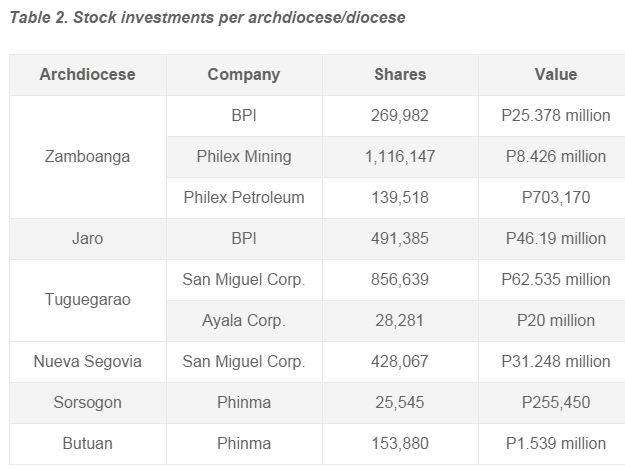
Rappler recently release an article exposing (once again) the enormous wealth the Church has accumulated through time. It alleges that the Church (through its own dioceses and parishes) owns/ed at least 30 billion pesos in stocks!

30 BILLION PESOS, a major stockholder of the Bank of the Philippines Islands (BPI)! This could just be the tip of the iceberg. Imagine how far and how many poor people that 30 billion pesos could have reached (considering that most of it came from people's intended out-of-pocket donations) and helped.

Source: Rappler

Apart from BPI, the Church owns/ed stocks in First Philippine Holdings (FPH), Concrete Aggregates Corp., Central Azucarera de Tarlac (CAT), Philex Petroleum (PXP), ISM Communication Corp., and Philodrill. All these stocks owned by one archdiocese, the Archdiocese of Manila, which for the renovation of and repair of the Manila Cathedral didn't spend a single centavo - everything was paid for by philantropists! Plus, the government does not even tax religious transactions!

But wait, there's more! Here are some other stocks owned by the Church.

Source: Rappler

This is an eye-opener. We all have met people who (blindly), even with so little money that they have, give most of what they have, in the belief that all these will return to them somehow, many-folds. But, if this is what the Church continuously preaches, then why hasn't the Church used even just a fraction of  its money reserves to alleviate the sufferings of the needy or help educate bright minds without brainwashing or forcefully imposing on them their teachings?

And whether or not the Church has sold its stocks in these companies, the truth is it's wealthy. And with big cash piles, and a portfolio of private schools, hospitals and other businesses, it can do better to lift people out of poverty. The Church exists not only to guide us, but in order for us to serve God, to give back, with FULL trust that the Church will act according to its purpose - to change people's lives and help those who faltered rise  up again.

I know the Church has its good side. It's able to make people more human, more emphatic, more gentle, more loving. But the Church can do more in this society. It can play a great role in shaping the future of generations that will come. It can wield power and influence the less knowledgeable - to do better and be better.

It can make use of its cash (our donations) reserve to really make a difference and really show to those who turned their backs against them, that the Church is sincere in contributing to progress, that it is a reliable institution, that it is as God wanted it to become - the venue to praise and glorify Him by making life less difficult for others, not the other way around.

-------------------------------------------------------------------------------------------------------------------------
On a brighter note, at least we now know the Church cares for its financial future. We're assure the Church can still help people ten, twenty, thirty years from now. :)